 EN
EN RO
RO
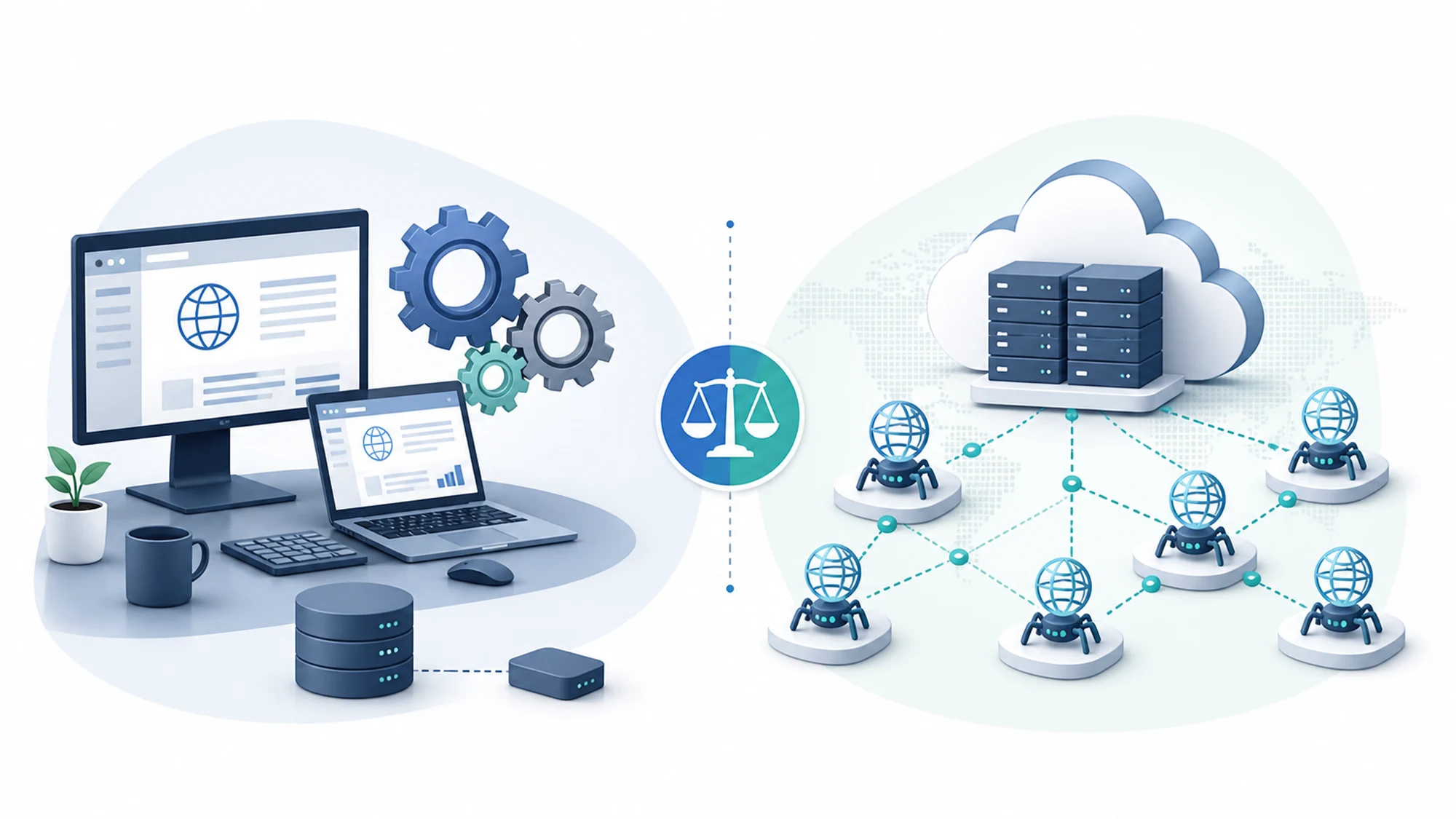
Any business owner who needs data extracted automatically from the web ends up at the same crossroads: hire or reassign a developer to write and maintain crawling scripts, or pay a monthly fee to an external provider that delivers already-clean data? The right answer depends on your data volume, how often you need it refreshed, and how much every developer hour pulled away from your core product really costs you.
The "in-house vs outsourced web crawling" choice is not just a technical decision, it is a resource-allocation decision. A small online store can lose months building infrastructure that a specialized provider already has ready to use; a large retailer monitoring dozens of sources around the clock can end up paying an outsourced service more than an in-house team would cost over time. This guide compares real costs, risks, and the criteria that show when each option makes sense.
What in-house crawling and an outsourced crawling service actually mean
In-house crawling means your company hires or reassigns a developer (or a team) who writes, runs, and maintains custom scripts that extract data from target websites — a software program, called a bot or crawler, that navigates web pages and pulls out relevant information (price, title, product code, availability). Infrastructure (servers, proxies, monitoring) stays your responsibility.
An outsourced crawling service means a specialized provider builds and maintains the scripts for your target sources, manages the technical infrastructure, and delivers the data in an agreed format — Excel, a relational database, or a product feed — at the frequency set out in the contract.
What in-house crawling really costs you
The cost of an in-house crawling team does not stop at a developer's salary. It includes, at minimum, four components:
- Initial development time — every target site has its own HTML structure, so the extraction script has to be built and tested separately for each new source.
- Ongoing maintenance — target sites change structure without notice; a "forgotten" script can run for weeks and return incomplete or wrong data before anyone notices.
- Technical infrastructure — servers, proxies for larger volumes, monitoring and alerting for failures.
- Opportunity cost — developer hours spent on crawling are hours not spent on your core product, site, or features.
Orientative analyses from the international data-extraction market show that a small-to-medium in-house team (one to three developers, plus infrastructure) can add up to significant annual costs — figures vary widely by market and source complexity, but the pattern is consistent: the real cost almost always exceeds the initial estimate, because maintenance gets underestimated.
What an outsourced crawling service costs and what the price includes
An external crawling provider, like HappyWeb, prices projects based on three main factors: the complexity of the information collected, the data volume, and the collection frequency. Initial collection usually costs more and takes longer than subsequent runs, because a custom script has to be developed for each target site.
An outsourced service's price usually includes script maintenance (adapting to target-site changes), run monitoring, and data delivery in the agreed format — costs you would carry anyway with an in-house setup, just not itemized separately.
Comparison table: in-house crawling vs an outsourced crawling service
| Criterion | In-house crawling (your own team) | Outsourced crawling service |
|---|---|---|
| Initial cost | High (hiring/training, infrastructure) | Low-to-medium (per-project or subscription cost) |
| Time to first data | Weeks-to-months (building from scratch) | Days-to-weeks (already-specialized provider) |
| Long-term cost at large, constant volume | Can become more cost-effective once infrastructure is amortized | Recurring cost proportional to volume |
| Maintenance when the target site changes | Internal responsibility, needs your own monitoring | Usually included in the contract |
| Control over scripts and data | Full, own code and infrastructure | Limited to what the provider offers under contract |
| Risk of lost expertise | High if the key developer leaves the company | Lower, provider has a dedicated team |
| Flexibility for new sources | Depends on internal team availability | Usually fast, it's the provider's core activity |
When it makes sense to build an in-house crawling team
The in-house option becomes justified when at least two of the following conditions apply to your business:
- You already have an internal technical team with development experience and available time that won't affect other priorities.
- Your data volume is very large and constant (hundreds of sources, daily or more frequent updates), so an outsourced service's per-extraction cost would exceed your own infrastructure cost over time.
- The extracted data is core to a competitive advantage you don't want to expose to a third-party provider (for example, a highly sensitive pricing strategy).
- You need full control over the code, infrastructure, and development pace of related features (direct integration with other internal systems).
When an outsourced crawling service makes sense
An outsourced service is usually the more efficient choice when:
- You don't have a dedicated internal technical team, or its time is already allocated to your core product.
- You need data quickly, without waiting months for a custom script to be built and tested.
- Your number of sources and collection frequency varies — an outsourced service adapts faster to a new source than an internal team busy with other projects.
- You prefer a predictable, contract-based cost over a variable development and maintenance budget.
Common risks with each option and how to avoid them
- In-house risk — neglected maintenance. A script that isn't checked periodically can deliver wrong data for months before anyone notices. Mitigation: add automated validity checks on collected data (alert if an expected field is missing or the product count drops sharply).
- In-house risk — dependency on a single person. If one developer knows all the scripts, them leaving the company can stall your entire data pipeline. Mitigation: document scripts and share knowledge across at least two team members.
- Outsourced risk — provider dependency. If the provider can't deliver on time, your internal process stops. Mitigation: choose a provider with a verifiable track record and set clear delivery terms and late-delivery penalties in the contract.
- Shared risk — ignoring the target site's permissions. Extracting data without first checking
robots.txtand the source site's Terms and Conditions can trigger access blocks or contractual issues. Mitigation: always verify the target site's permissions before collection starts, regardless of who runs the crawling.
4-step practical plan for the in-house vs outsourced decision
- Estimate real volume and frequency. How many sources you want monitored and how often you need refreshed data — the answer determines whether amortizing an in-house team makes sense.
- Calculate the full in-house cost. Not just salary, but also initial development time, estimated maintenance, and the opportunity cost of developer hours spent on crawling.
- Request comparable quotes from 2-3 external providers. Specify volume, frequency, and desired delivery format for an accurate, comparable cost estimate.
- Compare over a 12-24 month horizon, not just the initial cost. An in-house team may look more expensive at the start but cheaper at large, constant volume; an outsourced service may look more expensive at large volume but removes the risk of neglected maintenance.
Frequently asked questions about in-house vs outsourced web crawling
Is it cheaper to crawl in-house or to use an outsourced service?
It depends on volume and frequency. For small volumes or one-off projects, an outsourced service is usually cheaper, since it removes development and maintenance costs. For very large, constant volumes, an in-house team can become more cost-effective long-term once infrastructure is amortized.
How long does it take to build an in-house team capable of crawling?
Orientatively, a few weeks for the first working scripts on simple sources, but months for a mature process with automated monitoring and organized maintenance across multiple sources.
Can an outsourced crawling service meet specific format requirements?
Yes. A serious provider delivers data in the agreed format — Excel, a relational database, or a product feed — set together with the client before the project starts.
What happens if the in-house team can no longer maintain the scripts?
Unmaintained scripts can deliver incomplete or wrong data without immediate warning. Adding automated validity checks and documenting processes reduces this risk, but doesn't eliminate it entirely — which is why many companies switch to an outsourced provider after such an experience.
Can you combine in-house crawling with an outsourced service?
Yes. Many companies use an in-house team for critical sources where full control is needed, and an outsourced service for additional sources or one-off market research projects, without expanding the internal team for every new need.
Conclusion: choose based on real cost, not just the sticker price
The choice between in-house crawling and an outsourced service doesn't come down to "which one costs less on paper." The real cost of the in-house option includes development time, maintenance, and lost opportunity; the outsourced option's cost has to be compared over the same time horizon, with the same volumes and frequencies. For most online stores without a dedicated technical team, an outsourced crawling service delivers usable data faster and with lower maintenance risk.
Want to find out whether an outsourced crawling service is the right fit for your data volume? Let's discuss your project or see the full service: Web crawling services.

Write a comment