 EN
EN RO
RO
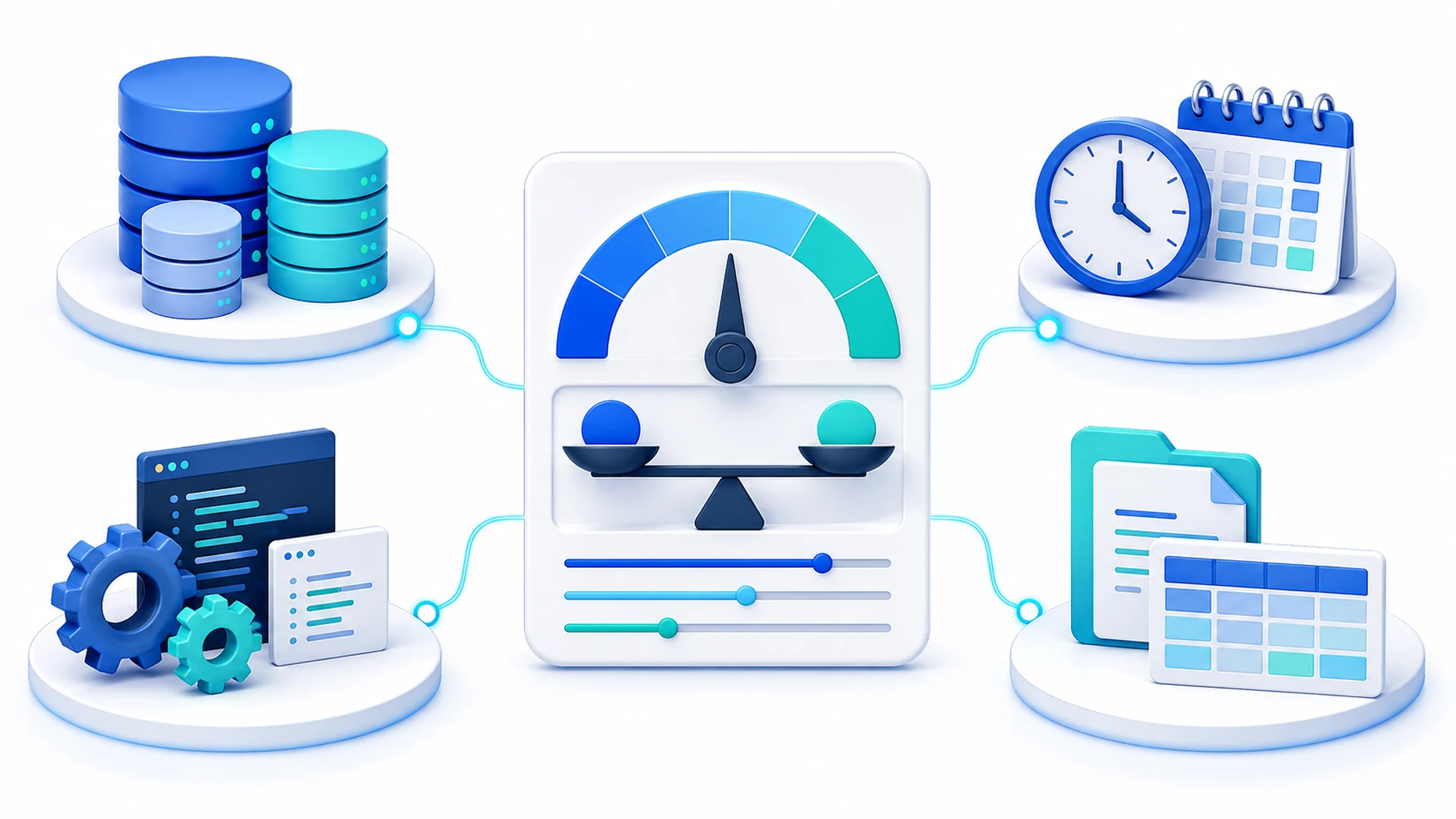
"How much will it cost us to automatically extract this data?" is, almost every time, the first question a client asks when discussing a web crawling project — and, almost every time, the correct answer is "it depends," because there is no fixed, universal price that applies to every data source.
The price of a web crawling project is mainly driven by the volume and complexity of the data collected, the desired collection frequency, and the fact that the first collection always involves script development costs that are higher than subsequent collections; on top of these three base factors come technical elements of the target site, the required delivery format, and the number of sources involved in the project.
This article walks through each cost factor, shows through a comparison table how each element influences the final price, discusses the real difference between building crawling in-house, with your own team, or working with an external service, and offers a practical checklist for requesting an accurate quote from any data collection provider.
The three main factors that determine the price of a web crawling project
Regardless of industry or target data source, the price of a web crawling project starts from the same three base variables:
- Data complexity and volume — how many pages need to be accessed, how many fields need to be extracted per product or record, and how "clean" the data is at the source.
- Desired collection frequency — a one-time extraction costs differently than daily or hourly monitoring, which requires ongoing infrastructure and maintenance.
- Initial script development — building and testing the crawling script for a new source always costs more than later collections, which reuse the already validated script.
These three elements are confirmed as the calculation baseline in the official description of the web crawling data collection service offered by HappyWeb, and the remaining factors discussed below add up, case by case, on top of this core.
How data volume and complexity influence the final price
Not all crawling projects are equally complex, even if they look similar at first glance. A simple extraction — for example, title, price and availability for a few hundred products from a single site — is relatively quick to build.
Complexity increases significantly when:
- the target site uses dynamic content loading (JavaScript), not static HTML, which requires a more advanced extraction method;
- page structure differs from one product category to another, and the script has to correctly identify each variation;
- the number of fields to extract is large (technical specifications, product variants, multiple images, stock across several warehouses);
- the data needs to be cleaned, normalized or mapped afterward onto your own structure (for example, for a product feed).
The more numerous these elements are, the more development time increases and, implicitly, the higher the initial cost of the project.
Collection frequency: a one-time extraction vs. continuous monitoring
A one-time data collection — useful, for example, for the initial population of a catalog — involves a single extraction and delivery cycle. Cost is almost entirely dominated by script development.
Recurring monitoring — daily, every few hours, or even hourly, as is the case with competitor price monitoring — adds, on top of the initial development cost, a recurring cost tied to scheduled runs, periodically checking that the target site's structure hasn't changed, and, if needed, adjusting the script when the source changes its page.
In practice, a higher frequency does not automatically mean "many times the cost of a one-time collection" — the recurring cost per run is usually much lower than the initial development, but a high frequency justifies a more robust running and monitoring infrastructure.
Why the first collection costs more than the following ones
One aspect that often creates confusion for clients is the difference between the cost of the first project and the cost of later collections from the same source.
The first collection requires building the script from scratch: identifying the target site's structure, writing extraction logic for each page type, testing the results and fixing any parsing errors. This is the step that consumes the most development time.
Later collections from the same source reuse the already built and validated script, which is why they usually cost considerably less than the first run — except when the target site has changed its structure in the meantime and the script needs adjustments.
Other factors that can increase or reduce the price of a web crawling project
Beyond the three base factors, there are several other elements that influence the final price, sometimes significantly:
- Anti-bot measures on the target site — captchas, rate limiting, or aggressive blocking of automated traffic increase development time and may require additional technical solutions.
- Number of sources involved — a project that aggregates data from multiple suppliers or competitors usually requires a dedicated script for each source, with its own structure.
- Required delivery format — a simple Excel export is faster to deliver than a direct integration into a relational database or a structured XML/CSV feed matching an external platform's requirements.
- Need for additional legal verification — for sensitive sources or large data volumes, carefully checking the target site's robots.txt and Terms and Conditions adds time to the planning stage.
On the other hand, price can go down when data is already well structured at the source, when the target site explicitly allows automated access, or when the project reuses a script already built for a similar source.
Comparison table: how each factor impacts the price
The table below summarizes the typical impact of each factor discussed above, a useful quick reference before requesting a quote.
| Factor | Typical price impact | Note |
|---|---|---|
| Small data volume, simple structure | Low | Fastest and cheapest development scenario |
| Large volume or structure varying by category | Medium-high | Increases mapping and testing time for the script |
| One-time collection (catalog population) | Medium | Cost dominated by initial script development |
| Recurring monitoring (daily/hourly) | Medium, with low recurring cost per run | Requires scheduled run infrastructure |
| Site with advanced anti-bot measures | High | Requires additional technical access solutions |
| Simple delivery (Excel) | Low | Direct export, no further mapping |
| Delivery via structured feed or database integration | Medium-high | Requires mapping to the format the platform requires |
The values in the table are indicative and serve as a discussion reference, not a fixed price list; the exact cost depends on the specifics of each target site and project.
In-house crawling (own team) vs. external service: what pays off long-term
A common budgeting decision is whether to build the project in-house, with your own development team, or outsource it to a specialized provider.
An in-house team can technically build a crawling script, but the real cost includes the developers' time allocated to a task outside their core work, the long-term maintenance whenever the target site changes its structure, and the legal verification (robots.txt, Terms and Conditions) that development teams don't always treat as a standard step.
A specialized external service amortizes these costs through experience gained on similar projects, through scripts already tested for common site patterns, and through a process that includes legal verification from the start, not as a step added later. The difference becomes even more visible the more sources a project involves or the higher the collection frequency.
How to request an accurate quote for a web crawling project: what to prepare
An accurate, fast price quote depends directly on how clearly the project is described before requesting a quotation. Practical checklist:
- Identify exactly the target site or sites and the approximate number of pages or products to extract.
- List the data fields you need (title, price, product code, description, images, stock, specifications).
- Decide on the desired frequency: a single collection or recurring monitoring, and at what interval.
- Specify the preferred delivery format: Excel, database, XML/CSV feed, or direct integration.
- Check, if you can, whether the target site publishes a restrictive robots.txt file or explicitly prohibits automated extraction in its Terms and Conditions.
- Tell the provider whether the project involves a single source or several, with different structures.
With this information ready, a web crawling service provider can accurately estimate development time and offer a realistic quote, instead of a generic price that ignores the real complexity of the project.
Related crawling articles
- Web crawling vs official API: how to choose the right method
- Automated competitor price monitoring through web crawling
Frequently asked questions about web crawling pricing
How much does a web crawling project cost on average?
There is no single average price that applies to every project, because each target site and each data volume requires a different development effort. The most accurate way to find out the real cost is to describe the source, the data volume, and the desired frequency, and request a personalized quote.
Why does the first data collection cost more than the following ones?
Because the first collection requires building and testing the crawling script for that source from scratch. Later collections reuse this already validated script, which is why they usually cost much less.
Does a recurring crawling project cost the same every time?
No. The recurring cost per run is usually much lower than the initial development, except when the target site changes its structure and the script needs to be adjusted.
Is web crawling cheaper than using an official API?
It depends on the source. An official API, if it exists and covers the needed data, removes the need for a dedicated extraction script, but may have its own access costs or volume limits. Crawling becomes relevant precisely when there is no official API or it doesn't cover enough data.
What factors can reduce the cost of a web crawling project?
Data that is already well structured at the source, a target site that explicitly allows automated access, a smaller number of fields to extract, and reusing a script already built for a similar source usually reduce the final project cost.
Conclusion: web crawling pricing reflects real extraction effort, not a flat rate
The price of a web crawling project is not an arbitrary sum, but the direct result of data volume and complexity, the desired collection frequency, and the initial script development effort. Knowing these factors before requesting a quote lets you correctly assess whether a price is justified and helps you prepare the information that makes the difference between a generic estimate and a realistic quotation.
Want a price estimate for your web crawling project?
HappyWeb builds custom crawling scripts, with a quote adapted to the volume, frequency, and delivery format your project requires. See the full web crawling data collection service or discuss your project directly with our team, for a concrete quote.
Sources
Last article update: 2026-07-09 · Recommended review: within 90-180 days, since market practices and target site technologies can change.
- HappyWeb — Web crawling data collection services, definition, use cases and pricing factors: happyweb.ro/en/services/services-web-crawling.
Note: the cost-impact values in this article are indicative and do not represent a fixed price list. For an exact estimate, we recommend requesting a personalized quote, adapted to the actual source and data volume of your project.
Image generated with AI, used for illustrative purposes.

Write a comment