 EN
 RO

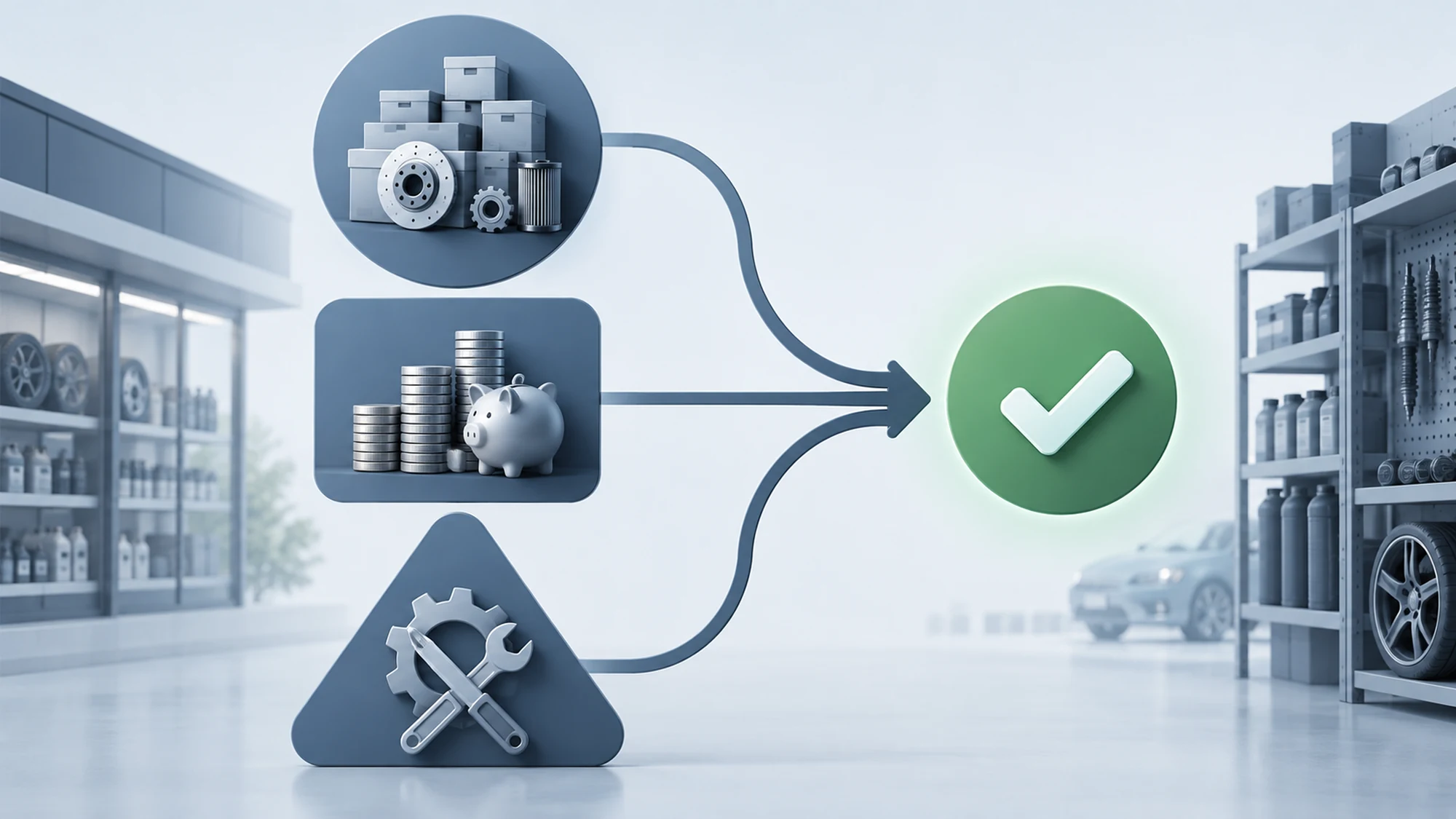
"Do we need to integrate TecDoc?" is a question asked often by auto parts store owners who see competitors with a TecDoc catalog and assume not having one means lost sales. The correct answer is not "yes, always" or "no, it's too expensive" - it depends on three measurable factors: how many SKUs you manage, what real budget you have for licensing and development, and whether your technical team can support an API integration after launch.
This article gives a decision checklist built around these three factors, plus a summary table so you can quickly see where your store falls and what alternative makes sense if TecDoc isn't justified yet.
When TecDoc actually solves a real problem
TecDoc makes sense when the store's problem isn't the absence of a catalog, but scaling one. A store with a few hundred manually entered products can function fine without TecDoc. The problem appears when the number of references grows beyond what the team can maintain manually (vehicle-part mapping, OEM codes, technical descriptions), or when customers explicitly search by VIN or OEM code and the store can't respond to that type of search.
If the main lost-sales driver is visitors not finding a part compatible with their car, not a lack of traffic, integrating a structured catalog like TecDoc addresses the actual cause, not the symptom.
Criterion 1: catalog SKU volume
Reference volume is the first measurable signal that a manual catalog is hitting its limit. Below a certain threshold, manual maintenance cost stays reasonable; above it, cost grows disproportionately relative to available resources.
| SKU volume | Typical situation | Rough recommendation |
|---|---|---|
| Under 2,000 | Manually managed catalog, small team, supplier catalogs entered directly | TecDoc likely premature; a proprietary catalog remains sufficient |
| 2,000 - 20,000 | Growing reference count starts to exceed the time available for accurate manual maintenance | Transition zone; TecDoc is worth evaluating seriously |
| Above 20,000 | Vehicle-part mapping and manual updates become practically impossible to sustain consistently | TecDoc becomes, in practice, hard to replace with an in-house solution |
The thresholds above are indicative, not fixed rules - a store with 5,000 SKUs in a single narrow category (filters only, for example) can manage manually more easily than one with 3,000 SKUs spread across dozens of categories and brands.
Criterion 2: real available budget
Budget for a TecDoc integration doesn't mean just the TecAlliance license cost. It includes at minimum four components: the license, initial integration development, ongoing maintenance (synchronization, schema updates) and the team's time allocated to verifying fitment data before launch.
- TecAlliance license - recurring cost, variable depending on the plan chosen and access volume; confirm directly with TecAlliance, don't estimate generically.
- Initial development - API integration, catalog import, mapping your own categories onto the TecDoc structure, testing at real data volume.
- Maintenance - periodic price/stock sync, schema updates, monitoring mapping errors after launch.
- Human verification - time allocated for manually validating fitment data on high-sales-volume categories before going live.
A store that can only cover the license cost, but not development and ongoing maintenance, risks ending up with an integration that's started and never properly finished - a more costly situation long-term than postponing the project until the budget covers all four components.
Criterion 3: technical team capacity
TecDoc is consumed through an API/WSDL service, not a one-off Excel import file. That means real technical knowledge is needed for integration, recurring synchronization and ongoing maintenance - either in-house or through a dedicated external partner.
Signs the current technical team can't sustain a TecDoc integration alone: no developer familiar with API/WSDL integrations, no deployment and monitoring process for recurring services (catalog sync), or the team is fully occupied maintaining the existing store, with no time allocated for a new project of this complexity.
The real choice here isn't "TecDoc yes or no", it's "in-house or with an external partner" - many stores with enough budget and SKU volume for TecDoc choose to outsource the integration and initial maintenance, keeping control over the store itself.
Observable signals: a checklist before the matrix
Before applying the investment criteria, check whether the problem already exists in daily work. The ticks are not an automatic score, and no single signal forces a store to adopt TecDoc; they show where cost and impact deserve measurement.
- Customers: repeated VIN, OE-code or vehicle searches, many empty results and frequent requests to confirm compatibility.
- Operations: the team repeatedly enters the same attributes, answers the same fitment questions or often corrects wrong part-to-vehicle links.
- Catalog: new suppliers and brands make manual maintenance unsustainable, while technical data and images remain inconsistent.
- Market: customers abandon because they cannot identify a part themselves, while relevant competitors offer structured vehicle filtering.
- Technical: the store has an extensible platform, can run synchronization and monitoring, and has an owner for data quality after launch.
Record each signal with evidence from searches, tickets, orders and team time. If it appears only in one category, test the integration there before expanding. If many signals are present but budget or technical support is missing, the checklist result is "prepare the project", not "start immediately".
Decision matrix: combining the three criteria
| SKU volume | Budget covers license + development + maintenance | Technical team available (in-house or external) | Rough decision |
|---|---|---|---|
| Under 2,000 | Doesn't matter | Doesn't matter | Postpone TecDoc; optimize the proprietary catalog first |
| Above 2,000 | Yes | Yes | Worth starting a TecDoc project |
| Above 2,000 | Yes | No | Look for an external partner for integration and maintenance |
| Above 2,000 | No | Yes/No | Postpone until budget covers maintenance too, not just the license |
What to do if the answer is "not yet"
If the store falls below the SKU threshold or the budget doesn't cover all four components, TecDoc isn't a permanent loss - it's a correctly postponed decision. Until the right moment, a few actions make sense without the cost of a full integration:
- Structure the proprietary catalog with manually entered OEM codes for top-selling categories, so you at least cover code-based search for your best-selling parts.
- Monitor SKU count growth monthly, so you objectively notice when it approaches the transition threshold.
- Set aside budget gradually for all four components (license, development, maintenance, verification), not just the initial license.
- Talk to a technical partner about realistic cost and effort estimates before you have an urgent need, so the decision isn't made under time pressure.
Common risks when this checklist is skipped
The most frequent mistake isn't choosing TecDoc too early, it's starting a project without evaluating all three criteria together - for example, sufficient SKU volume and an approved license budget, but no technical capacity for maintenance after launch.
The typical outcome: integration started, catalog imported, but price and stock synchronization remains an ad-hoc task, and after a few months the displayed catalog visibly diverges from actual stock. This situation costs more than postponing the project by a few months, until all three criteria are met simultaneously.
Frequently asked questions about deciding on TecDoc integration
Is there a minimum SKU count below which TecDoc never makes sense?
There's no fixed universal threshold, but as a rough guide, under 2,000 SKUs the maintenance cost of a proprietary catalog usually stays lower than the cost of a full TecDoc integration (license, development, maintenance).
Can I integrate TecDoc without an in-house technical team?
Yes, through collaboration with an external partner who handles integration and maintenance, as long as the budget covers both initial development and ongoing synchronization after launch, not just the license cost.
What happens if I start the integration and the maintenance budget later falls short?
The catalog risks staying outdated - price, stock and fitment data gradually diverge from reality in the ERP, which damages customer trust more than not having the integration at all.
Is it worth starting with a smaller TecDoc plan and scaling up later?
Yes, if the chosen plan genuinely matches the scope defined upfront (see also the planning mistakes behind failed TecDoc projects) and it's clear the plan can be upgraded later without a major migration.
Conclusion
The decision to integrate TecDoc shouldn't be based on what competitors are doing, but on three verifiable criteria within your own store: SKU volume, a budget that covers all project components, and the technical team's real capacity to sustain the integration after launch. When all three align, TecDoc is usually a justified investment; when they don't, an informed postponement beats a project started too early and abandoned halfway.
Want a concrete assessment of whether your store needs TecDoc integration now or later? Let's talk about your specific situation.

Write a comment